
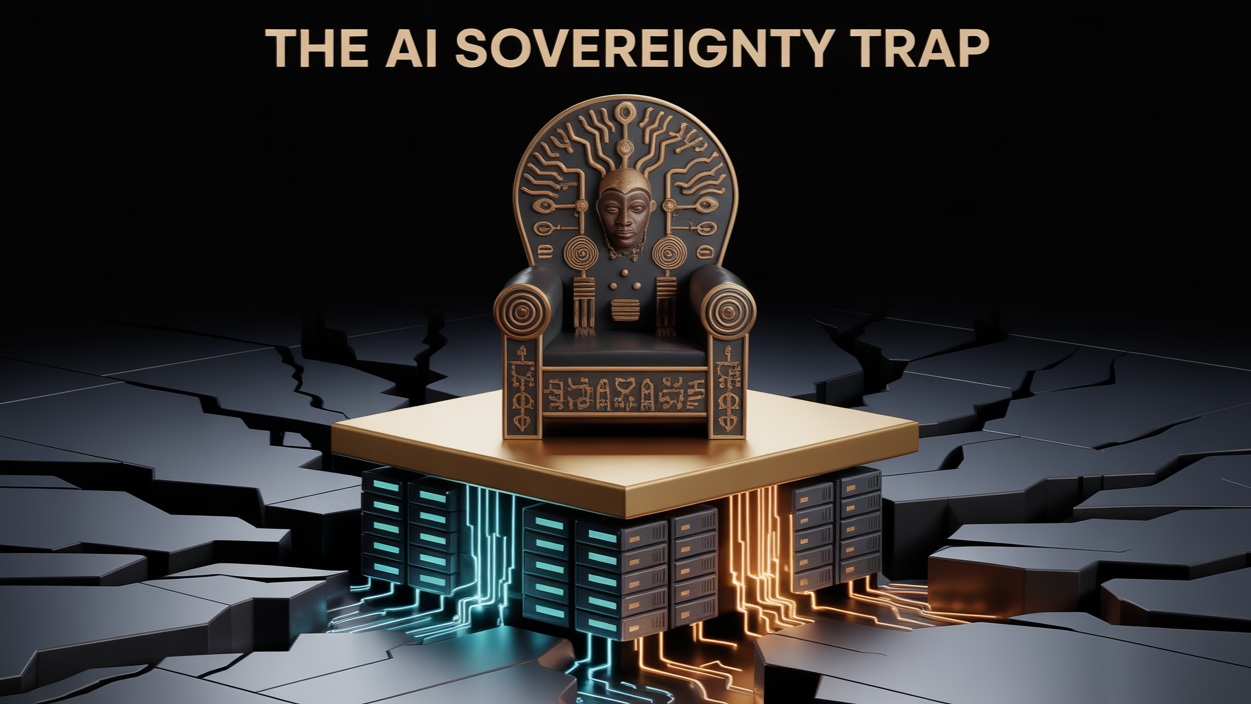
Most African nations pursuing “AI strategies” are building dependencies, not sovereignty.
Every week, another African nation announces its “National AI Strategy.” Ministers pose with documents. Press releases celebrate “positioning for the Fourth Industrial Revolution.” The documents all say the same things: ethical AI, AI for development, AI innovation hubs, AI skills training. None of them mention who owns the servers.
This is the AI sovereignty trap. African governments are drafting policies for technology they don’t control, running on infrastructure they don’t own, trained on data they can’t access. We’re regulating the application layer while foreign powers control the foundation.
The result isn’t sovereignty. It’s dependency with better branding.
THE REGULATORY THEATER
When Ghana, Kenya, Nigeria, and South Africa publish AI strategies, they’re largely copying European frameworks: the EU AI Act, GDPR principles, “trustworthy AI” language. The problem: Europe built those frameworks for a different problem.
Europe regulates AI because European companies build AI at scale. The regulatory challenge is managing domestic innovation that might cause harm. When you have Google, DeepMind, and Mistral, you need guardrails.
Africa’s challenge is different. We’re not managing domestic AI innovation at scale, we don’t have it. We’re managing dependency on foreign AI infrastructure. The EU regulates its champions. We’re writing rules for other people’s technology.
This matters because regulatory frameworks designed for innovation management don’t address infrastructure sovereignty. The EU AI Act governs algorithmic transparency and risk classification. It doesn’t ask: “Who controls the compute?” That question is irrelevant when the compute is domestic. For Africa, it’s the only question that matters.
THE INFRASTRUCTURE REALITY
AI sovereignty has a simple definition: the ability to train, deploy, and operate AI systems without dependence on foreign infrastructure or foreign permission.
This requires three things:
1. Compute Infrastructure
AI training requires massive computational power: GPUs and TPUs running 24/7 in data centers. Training a frontier AI model costs $50-100 million in compute alone. Even smaller, specialized models cost millions. Where does African AI run? AWS (American), Google Cloud (American), Microsoft Azure (American), Alibaba Cloud (Chinese). Every African “AI startup” is a tenant on foreign infrastructure. When those companies decide to restrict access, whether for geopolitical reasons, sanctions, or commercial strategy, African AI capabilities evaporate overnight.
We saw this in miniature when Russia invaded Ukraine. Western cloud providers cut off Russian access within days. Russian AI companies couldn’t train models. Their applications stopped working. Years of development became inaccessible. African governments assume this won’t happen to them. They’re wrong. When great power competition intensifies, neutrality offers no protection. Infrastructure dependency is strategic vulnerability.
2. Data Sovereignty
AI models are trained on data. The quality and relevance of that data determines model performance. If African data flows exclusively to American and Chinese servers, which it does then the most valuable models for African contexts get trained abroad.
Healthcare AI trained on African disease patterns? That data sits in foreign clouds, accessible to foreign companies, governed by foreign law. Agricultural AI trained on African soil conditions? Same story. Financial AI understanding African payment behaviors? Already captured by foreign fintechs.
The long-term consequence: African problems get solved by foreign AI companies using African data, with African institutions paying licensing fees to access solutions built from their own information. This isn’t partnership. It’s extraction with algorithms.
3. Technical Capacity
AI sovereignty requires domestic technical talent capable of building, deploying, and maintaining AI systems. This isn’t about producing more computer science graduates, African universities do that. It’s about building the specialized expertise required for large-scale AI infrastructure. Training frontier AI models requires expertise in distributed computing, optimization at scale, hardware-software co-design. Operating sovereign AI infrastructure requires cloud architecture, security engineering, and reliability engineering at scale. These are not skills acquired through online courses.
Countries that achieve AI sovereignty: the United States, China, and increasingly the UAE and Singapore invest billions in research infrastructure and hire global talent. African nations announce AI strategies and allocate $5 million for “innovation hubs.”
The gap between ambition and investment isn’t a funding shortfall. It’s a strategic misunderstanding.
WHO’S GETTING IT RIGHT
Three countries demonstrate what actual AI sovereignty requires: Singapore, the UAE, and China. None of them started by writing regulatory frameworks.
Singapore: Sovereign Cloud as Foundation Singapore understood that digital sovereignty requires infrastructure sovereignty. In 2020, it began building a national AI compute platform; sovereign infrastructure for domestic AI development. The government invested directly in GPU capacity, trained specialized engineers, and created commercial incentives for companies to use domestic infrastructure.
Singapore didn’t ban foreign cloud providers. It created an alternative. Companies can use AWS or Google Cloud, but they have a sovereign option if geopolitical risk increases. This is optionality. This is sovereignty.
The Singapore model costs real money, $500 million to $1 billion in initial capital, plus operating costs. But Singapore recognized that digital dependency carries strategic costs that dwarf infrastructure investment.
UAE: Strategic Capital Deployment The UAE took a different path: deploy capital to own critical AI infrastructure globally, then build domestic capacity on that foundation. Abu Dhabi’s MGX and other sovereign vehicles invested $50+ billion in AI companies, compute infrastructure, and chip manufacturers.
The UAE didn’t wait to “develop local talent first.” It hired global talent, paid premium salaries, and built infrastructure at scale. Now it has Falcon LLM, an Arabic-focused language model trained on domestic infrastructure using domestic capital. The UAE didn’t ask permission. It bought the capability.
This approach requires capital and decisiveness. The UAE had both. African nations have capital (sovereign wealth funds, pension assets, central bank reserves). They lack the decisiveness to deploy it strategically.
China: The Full Stack China provides the clearest example of AI sovereignty not because it’s a model to copy wholesale, but because it demonstrates what comprehensive strategy looks like. China identified AI as strategic priority in 2017. Within five years, it had: built domestic cloud infrastructure at scale (Alibaba Cloud, Huawei Cloud), developed domestic AI chips (Huawei Ascend), trained domestic frontier models (Baidu, ByteDance), banned foreign AI services to force domestic adoption, and deployed capital to ensure Chinese companies led in specific AI domains.
When the United States restricted Chinese access to advanced chips, China had domestic alternatives, lower performance, but functional. This is resilience. This is sovereignty.
African nations can’t replicate China’s authoritarian industrial policy. But they can learn the strategic logic: sovereignty requires infrastructure, capital, and protection of domestic capabilities. Everything else is decorative.
THE AFRICAN MIRAGE
A handful of African nations are making serious moves toward digital sovereignty, though none yet at the scale required for AI sovereignty.
Rwanda has been the most consistent. The government built domestic data center capacity, required government data to stay on Rwandan servers, and used procurement power to force infrastructure localization. Rwanda’s approach isn’t about AI specifically, it’s about digital infrastructure sovereignty as foundation. AI sovereignty, if Rwanda achieves it, will be built on that base.
South Africa has technical capacity but inconsistent policy. The country has world-class engineers, strong universities, and existing compute infrastructure. What it lacks is strategic coherence. AI policy documents talk about ethics and innovation, but infrastructure sovereignty isn’t prioritized. This is capability without strategy, the most frustrating form of failure.
Nigeria has the market size to justify sovereign infrastructure investment but continues to optimize for short-term consumption rather than long-term capability building. The focus remains on “enabling startups” (which rent foreign infrastructure) rather than building domestic alternatives. Market size without strategy produces large-scale dependency, not sovereignty.
WHAT AI SOVEREIGNTY ACTUALLY REQUIRES
If an African nation genuinely wanted AI sovereignty, the roadmap is clear. The question is whether political leadership will accept the price.
Phase 1: Infrastructure Optionality (Years 1-3, $500M-1B investment) Build domestic compute capacity sufficient for specialized AI applications. This isn’t about competing with AWS globally—it’s about having sovereign options for critical applications (healthcare, finance, defense, government systems).
Start with mid-scale GPU clusters (5,000-10,000 GPUs), co-locate with renewable energy to manage operating costs, and hire 50-100 specialized engineers globally to build and operate infrastructure. Require government systems and critical infrastructure to run on sovereign compute first, commercial cloud as backup not the reverse.
This phase isn’t profitable. It’s national security infrastructure, like defense or diplomatic presence. The return is strategic, not financial.
Phase 2: Data Localization with Teeth (Years 2-5) Pass data localization requirements that actually matter: healthcare records, financial transactions, government data, and telecommunications metadata must be stored on domestic or regional infrastructure.
Enforce with procurement pressure: government contracts prioritize companies that use sovereign infrastructure. Create tax incentives for businesses that localize data and computing. Impose material penalties for violations.
This will anger foreign tech companies. They will lobby against it. They will threaten to reduce investment. This is the test of political will. Countries that fold under pressure remain dependencies. Countries that hold firm build sovereignty.
Phase 3: Talent and Capital (Years 3-7, $2-5B deployment) Create “AI Sovereignty Fellowships” paying globally competitive salaries ($200K-500K) to attract top African diaspora AI researchers home. Not for six-month consulting visits, for permanent roles building domestic capability.
Deploy sovereign capital into domestic AI companies with ownership stakes, not grants, equity. If Rwandan or Nigerian AI companies succeed, the sovereign wealth fund or development bank should own 20-40%. This is how China, Singapore, and the UAE built capability, patient capital with strategic ownership.
Partner with one serious foreign technology company (not all of them, one) for genuine technology transfer. Not a “training partnership” or “innovation lab.” Actual transfer: source code, architectural knowledge, engineering processes. This requires negotiating from a position of strength, which means having alternatives.
Phase 4: Regional Coordination (Years 5-10) No single African nation except possibly Nigeria has the scale to justify fully sovereign AI infrastructure alone. Regional cooperation isn’t idealistic, it’s economically rational.
The East African Community, ECOWAS, or SADC could pool resources to build shared sovereign compute infrastructure. This requires political coordination that Africa has historically struggled with, but the economics are compelling: five countries investing $200M each creates infrastructure none could justify alone.
The model exists: the European Organization for Nuclear Research (CERN). Shared infrastructure for strategic capability. Africa needs CERN for AI: a pan-African compute facility that gives member states sovereign options.
THE COST OF PRETENDING
The alternative to building AI sovereignty is continued dependency. This has predictable consequences:
Economic: African institutions pay licensing fees indefinitely for AI tools built on African data. Value extraction continues, this time with machine learning.
Strategic: When geopolitical competition intensifies, U.S.-China decoupling accelerates, sanctions regimes expand, African nations discover they have no control over critical digital infrastructure. AI-powered systems stop working because foreign providers restrict access.
Developmental: African problems get solved last, if at all, because AI companies optimize for wealthy markets. Healthcare AI prioritizes diseases prevalent in wealthy nations. Agricultural AI focuses on crops grown in temperate climates. African-specific solutions remain perpetually “coming soon.” The gap compounds. Countries with AI sovereignty pull further ahead. Countries with AI dependency fall further behind. The window to act narrows each year.
THE POLICY CHOICE
African governments face a decision, and they cannot defer it much longer. Either commit real resources to building AI sovereignty: infrastructure, capital, talent, political will or accept permanent technological dependency.
Both are legitimate choices. Dependency has advantages: lower upfront costs, faster deployment, access to cutting-edge capabilities without building them. Switzerland is dependent on American AI infrastructure. It’s doing fine. Dependency doesn’t automatically mean dysfunction.
But dependency must be chosen with clear eyes, understanding the strategic trade-offs. What African governments cannot do is pretend that an AI policy document creates sovereignty. Regulations without infrastructure are theater. Strategy without investment is fantasy.
If the decision is sovereignty, the path forward requires rejecting the easy approaches: no more “innovation hubs” as substitute for infrastructure, no more “partnerships” that are really procurement, no more celebrating AI startups that rent foreign cloud services as if they represent domestic capability.
Real sovereignty requires building data centers, deploying billions in capital, hiring world-class engineers at global salaries, and accepting short-term friction with foreign technology companies. It requires presidential-level political commitment and multi-year budget allocations that survive electoral cycles.
If the decision is dependency, that too must be strategic. Negotiate better terms. Demand data localization for sensitive applications. Build technical capacity even if infrastructure remains foreign. Ensure optionality, multiple vendors, no single point of failure.
But don’t pretend a policy document is a strategy, and don’t claim sovereignty while running entirely on foreign servers.
The AI age is here. African nations can build sovereign capability or rent it permanently. Both paths have costs. Only one path preserves strategic autonomy.
The question isn’t whether African nations can afford to build AI sovereignty.
The question is whether they can afford not to.
RESET GLOBAL designs AI governance frameworks aligned with infrastructure reality not aspirational policy documents disconnected from technical capacity. If your institution needs to move from AI theater to AI strategy, limited advisory capacity remains for Q1 2026. For enquiries: intelligence@resetglobal.org
Futurist Kwame is a strategic advisor focused on technology sovereignty, institutional architecture, and long-term economic strategy. He leads Reset Global, an intelligence and foresight bureau working with governments and institutions across Africa.