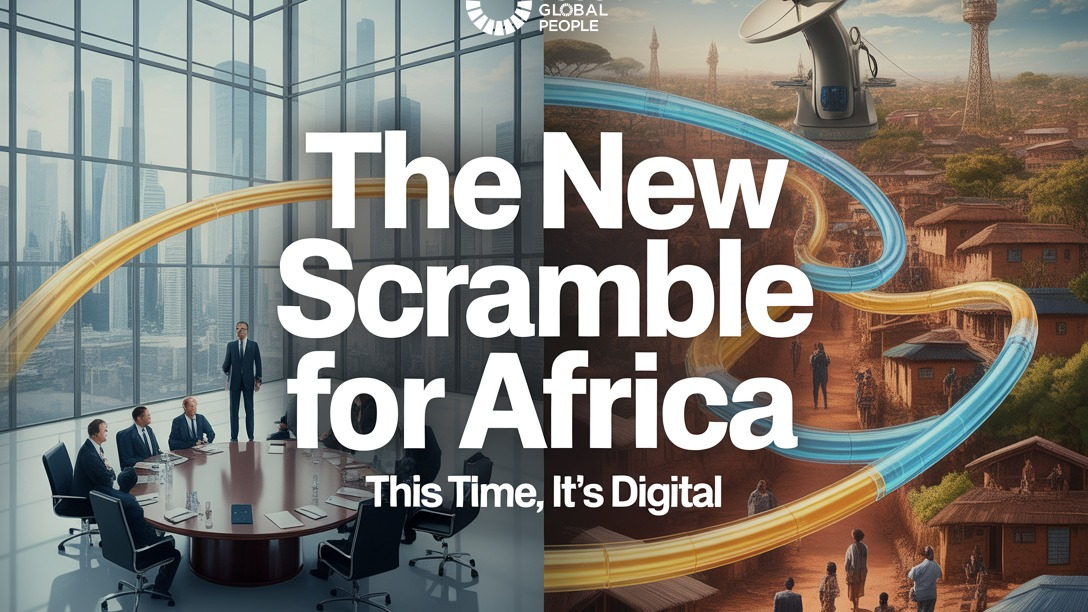
We speak endlessly about sovereignty, our borders, our resources, our futures. Yet while we guard physical boundaries, the most consequential division of our continent is happening in plain sight: the carving up of Africa’s digital territory.
Silicon Valley and Beijing aren’t negotiating with us. They’re simply building the infrastructure that will define the next century of African life, and with it, claiming ownership of something more valuable than gold or oil: our data.
The Uncomfortable Truth
Every email sent through Gmail, every transaction on a foreign payment platform, every government record stored in AWS or Azure represents a small surrender of sovereignty. We’re not citizens of our own digital nations, we’re tenants, renting space in someone else’s cloud, governed by terms of service written in California and Beijing.
The question isn’t whether this matters. It’s whether we’ll do anything about it.
The Case for African Sovereign Clouds
Data is not just information, it’s power. It’s the ability to understand your population, predict economic trends, train AI systems, and build the next generation of technology. When African data flows exclusively through foreign servers, subject to foreign laws and accessible to foreign intelligence agencies, we’re surrendering more than privacy. We’re surrendering our future competitive advantage.
Consider what’s at stake:
Economic sovereignty: How can we build African tech champions when the training data for AI lives in Oregon and Shenzhen? How can our startups compete when they’re building on foundations controlled by their competitors?
Security sovereignty: Healthcare records, financial transactions, government communications, all potentially accessible to foreign powers. We’ve seen how data access translates to geopolitical leverage. Are we comfortable being permanently vulnerable?
Innovation sovereignty: The next breakthrough in agriculture, fintech, or healthcare for African contexts will come from African data analyzed by African minds. But only if we control that data.
But Let’s Be Brutally Honest About Reality
Here’s where most digital sovereignty conversations in Africa go wrong: they ignore physics, economics, and the current state of our infrastructure.
Energy is the elephant in the server room. Data centers are voracious energy consumers. A mid-sized facility can consume 10-50 megawatts continuously, enough to power tens of thousands of homes. Across much of Africa, we struggle to provide reliable electricity to our citizens. The idea of sovereign clouds sounds inspiring until you realize many of our cities face rolling blackouts.
The infrastructure gap is real. We need:
- Reliable, 24/7 power (likely requiring dedicated renewable installations)
- High-speed fiber connectivity across vast distances
- Cooling systems that work in hot climates
- Skilled technicians who can maintain sophisticated systems
- Regulatory frameworks that protect data while enabling innovation
Building this from scratch isn’t just expensive, it’s a multi-decade commitment requiring coordination between governments, private sector, and international partners.
The cost calculation is sobering. A single hyperscale data center costs $1-3 billion to build. Multiply that across a continent, add operational costs, and we’re talking about investments that dwarf many national budgets.
A Pragmatic Path Forward
Digital sovereignty doesn’t mean building everything immediately. It means being strategic about what we build, when, and with whom.
Phase 1: Strategic Partnerships with Conditions
- Negotiate data localization requirements with existing cloud providers
- Demand transparency in where African data is stored and who can access it
- Require technology transfer as part of any infrastructure deals
- Build local talent through partnerships, not dependencies
Phase 2: Regional Hubs, Not National Silos
- Identify 5-7 locations across Africa with stable power and connectivity
- Pool resources across nations for shared sovereign cloud infrastructure
- Focus initially on critical data: government, healthcare, financial services
- Use renewable energy from the start: solar and wind are increasingly cheaper than grid power
Phase 3: Leapfrog with Hybrid Models
- We don’t need to replicate everything the West built over 40 years
- Edge computing can reduce bandwidth and latency challenges
- Hybrid clouds can keep sensitive data local while leveraging global scale for less critical workloads
- Open-source technologies reduce licensing costs and foreign dependencies
Phase 4: The Long Game
- Train the next generation of African cloud architects, cybersecurity experts, and data scientists
- Create regulatory frameworks that encourage investment while protecting sovereignty
- Build interconnectivity between African sovereign clouds
- Develop African standards for data governance
The Energy Question Demands Innovation
The energy challenge is real, but it’s also an opportunity. Africa has some of the world’s best solar and wind resources. Co-locating data centers with renewable energy projects solves two problems at once:
- Provides anchor demand for renewable installations
- Creates energy-independent data infrastructure
- Positions Africa as a leader in green computing
Countries like Morocco, Kenya, and South Africa already demonstrate this is possible. We need to scale the model.
To African Policymakers
Every day you delay is a day more of our data flows offshore. Every procurement decision that defaults to foreign clouds is a choice to remain digital colonies. You don’t need to ban foreign providers, you need to create conditions where local alternatives can compete and grow.
Start with your own government data. Require it to stay on African soil. Use your procurement power to build the market for sovereign infrastructure. Create tax incentives for companies that localize data and build infrastructure.
To Tech CEOs
You face a choice: continue as branch offices of Silicon Valley and Shenzhen, or build the foundation for truly African tech giants. The companies that will dominate Africa’s digital future will be those that control the infrastructure, not just the applications.
Yes, building sovereign infrastructure is harder than renting cloud services. Yes, it requires capital, expertise, and patience. But the alternative is permanent subordination in the value chain.
The Historical Parallel Is Uncomfortable
In the late 19th century, European powers gathered in Berlin to carve up Africa without a single African in the room. Today’s digital carve-up is more subtle but no less consequential. The difference is we’re participating willingly, one cloud contract at a time.
We have a choice. We can continue as digital tenants, or we can become digital landlords, building the infrastructure that will power African prosperity for the next century.
The scramble for Africa never ended. It just moved online.
The question is: Are we going to let history repeat itself, or will we write a different ending?
What’s your perspective on digital sovereignty in Africa? Are we being too alarmist, or not urgent enough? Let’s debate this in the comments.
Kwame A.A. Opoku Futurist | Strategic Advisor & Global Speaker
#DigitalSovereignty #Africa #TechPolicy #CloudComputing #DataGovernance #AfricanTech #Innovation #DigitalTransformation